Reading books which talk about the differences in regional cultures of the US changed the way I think about politics here now. I used to have the normal sort of Democratic view that we're all equal individuals; where race wasn't super important and was better off ignored, to be fair. But now that progs have gone wild with saying that we actually should talk and think about race all the time, they lost me - and these books helped, because they gave a much stronger way to explain and predict things.
What is this belief?
It's that the best way to know and understand a person, town, region, or group is to look at their history and beliefs, and where they came from. It's really very simple.
If in their home country they were all rich educated scholars, well, that's what they're used to so they'll probably try that here. etc. And further, if they've been her a long time and have changed separately, well, figure out how they changed. But be warned: there is a ton of consistency over time, way more than you might expect. That claim is also shown by the books to a very high degree; they both show letters which could easily be facebook posts today where say a southerner complains about the behavior, pride etc of a northerner.
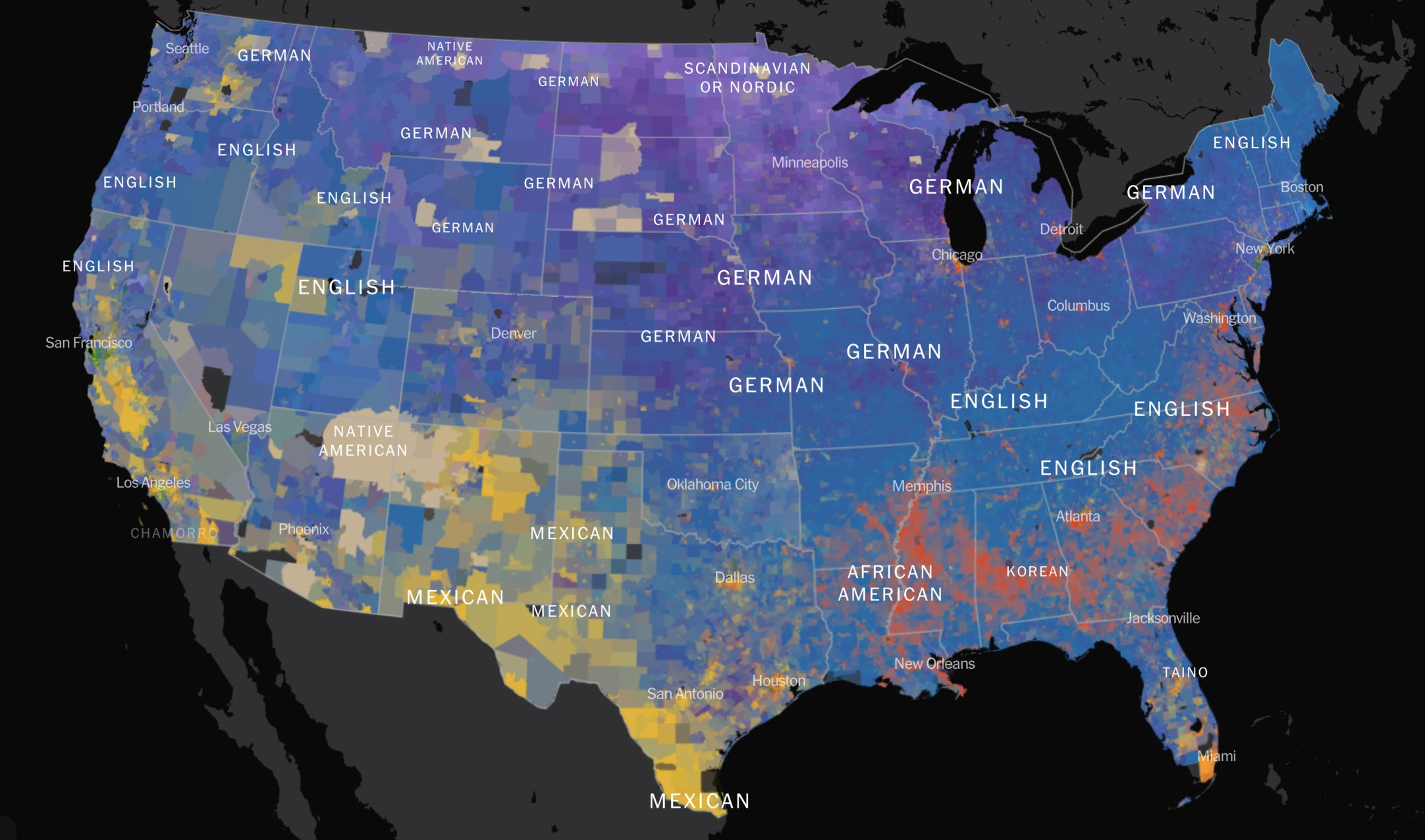
So, specifically, it claims that the major groups in the US have separate cultural traits. The groups are: Puritans (aka Yankees), Quakers (pa & the midwest), virginian cavaliers, borderer (appalachia) deep south (3 groups - elite whites from england, poor whites from england working as servants, and africans abducted into slavery) as well as other, smaller and/or newer ones. (And ofc you can keep breaking them down into subgroups for greater accuracy if you want.
Once I read this, it reformed how I viewed things like political conflict in the US.
Technical/Theoretical justification for how this separateness could exist, be maintained, and not be washed out
Probably the way it works is that an original population has enough similarity (in language, city of origin, or whatever) that many daily-life nash equilibrium choices or coordination defaults either brought over already set in the same way, so that what was previously a single-city-resident only trait became prevalent and reinforced over time within a larger region, due to monoculturalism.
After a while, the higher level "principles" of "living life" might be derived from that; say if someone noticed that in one region a highly valued trait was "honesty" then there'd be a bunch ways that'd have played out (and also would be used to determine new shared systems in that region, e.g. how to make phone calls in a polite way, as the phone was spreading).
Over time, there are forces strengthening and diluting it. strengthening: new tech and new parts of society are added, and norms are generated; if the group was monocultural before, the new norms will probably be even moreso. e.g. a group may show up which has only been unified for 100 years; so within it there may be still unresolved conflicts (i.e. freedom vs responsibility); but as new choices need to be made, it's hard for a unified group to choose "both" or to not choose; so newer choices will be more unified. Over time, the percent of choices being unified will go up; at some point, formerly held values aren't prevalent enough that they get extinguished.
Why is there variation at all?
Region, Tech level, and random
I claim that even say, groups of 20k identical people set down on identical locations, would, after some time, diverge, due just to chance. ofc they would likely be more similar to each other (even w/out contact) than that same set of people set down in a different environment, etc.
So, there is a theoretical basis for thinking things like this might happen
Also: I claim that higher levels of internal coherence or systematization of thinking patterns may enable themselves to survive even longer, even within transplanted pops. e.g. Puritan new englanders could move to other regions and for multiple generations maintain their old systems. (not saying forever, but once homogenization proceeds, it can intensify persistence of traits). Perhaps we could even measure the loss rates as a way to check the internal power or hold the beliefset has on people
So what happened to your beliefs, then, author?
So, since I'd now noticed that it was much more convincing and powerful to explain what's going on in the US than the post 1960s sort of dominant "anti-racism, anti-colonialism" kind of weird hippie nature-loving thing, I started applying it everywhere. In this new frame, one huge now-visible and important thing is that Puritans kind of run a lot of the country, and have specific relationships with - deep south, borderer, texans, midwesterners etc. Some pairs are nearly always negative, while others change. Puritans often openly express dislike for white southerners. And have a very hard time even admitting black southerners exist, since they have no way to really talk about them.
And that these relationships can be seen personally, too. I as a Yankee by even doing all this am showing my nature, too - It's a very yankee trait to try to help others by letting them know things they "should" know about how things "actually" work.
It's also remarkable how terribly the prior non-albion's seed system is at explaining the USA: trying to ask questions like "how do white people in the USA today feel about the history of slavery" is just so complex; the primitive "race vs race" view misses so many complexities which individuals have (i.e. white people whose entire ancestry was all on the union side, or whose ancestors weren't even in the US at that time; or the difference in life experience someone who is descended from (or even grew up among) people connected to that history, vs recent african immigrants. Of course proponents of today's mainstream view will retreat to a more sophisticated position if you really start discussing it; but they still have a really hard time explaining that obviously a white person in the deep south will (correctly) systematically behave and view their relationship to their neighborhood's black residents differently than a white person raised in MA. Trying to make the descendants of white puritans feel the way puritans think the descendants of white plantation owners should feel doesn't really make sense. Moreso, really, wokeism is a continuation of the always-present puritan tendency to self-examination, self-guilt-acceptance, and also to how they pretty much hate other groups and insist other groups conform to them. And for the truly competitive non-puritan groups, they dislike them so much that they valorize those groups' enemies (while still heavily pressuring everyone who goes to Harvard to culturally convert to modern puritanism). It's always been a bit weird to even imagine who white harvard people are supposed to get along with say, a wealthy black guy from alabama who is culturally alabaman (in that he's not obsessed with sin, constantly affirming propriety, checking he's not blocking the way other people need to walk or to see, etc.). This is why blues have a very hard time actually paying attention to what non-prong black americans say except just blocking or accusing them of being sellouts/frauds.
So at that point I was able to see why people who truly match my cultural background (i.e. native english certainly helps but maybe not absolutely required, plus they've been exposed to (or went to intense church) even if they've left, and have just learned this heme-set of valuing self-examination, trying to constantly think through ones life to avoid guilt, etc. So it's not at all surprising that people of any race who have this trait are fine to get along with; and it's not at all surprising that my co-ethnics who i don't share a culture with are kind of strange and uncomfortable to me. Like, duh. The really weird thing about this is that it's just all so obvious. Of course the person who speaks your dialect of language and morality and thought is mentally "closer" and "easier to get along with" than you. It's basic stuff, the oppose of those business books like "how to get along with people from other countries". Just model groups by how culturally different they are, give it time; dramatically lower race in your list of importance, (but then observe that FUNCTIONALLY it rises back up quite high, perhaps 80% of before; that's because you still should know someone is, say, bangladeshi born and raised, if you're trying to know him; but it's not cause of race, it's cause he's likely to have that culture. And unlike progs, you very much should care a lot if he is a rare sub-cultural group of bangladeshis - e.g. if he's part of a say tiny 1% religious minority in his home nation, but the same race, this system tells you the super obvious result that of course you should care about that, read what they are like, what books they read, their traits and values, their classics, if you want to know them. The total failure of the race-based world view is obvious.
Another obvious failure of systems other than this
the conventional view of american identity and cultural relationships totally fails on cases like Hmong. Visually they look like Chinese, yet progs tie themselves in knots trying to explain their different outcomes and behavior than Chinese. But people who just think about culture have no problem; the same old "people tend to behave consistently with the culture they had before" matches here.
And even within subgroups of chinese immigrants to America, same story - if they were elite scientists back home, good chance that's kind of how they'll be over here. etc etc. No magic needed.
Reiterating
It's trivially true, or should be seen so, that explanations which rely on clearly possible mechanisms, such as "a person is acting a certain way because they were told things, or they saw things, or had some information about that thing)" should be chosen over ones which rely on concepts like that there is one unified "asian" race in the mind of the US which determines their outcomes, regardless of how and where they were raised. The counterexamples could not be stronger; i.e. the reality is that immigrants into the US have outcomes which are fairly predictable based on that individual person or family's background, caveatted by "using your mind". i.e. if they came in poor, BUT the country they're coming from had stolen all their goods, and before that, they'd all been doctors, well, ill predict they'll be interested in being doctors in America too.
I suppose that there could be some kind of "concept of race" in the mind of america-at-large which informs how people initially treat others, regardless of if that person's actual family did the thing which the race is say, famous for doing; that's not a zero. e.g. if a white american sees a black american, they might assume things about them. But just like everything else in the world - once you know the guy was like, raised episcopalian in brussels, you should (and everyone DOES) change, even racist people; cause obviously being raised in an intense religion, and in europe, is a significant change compared to a small thing like race.
Like, this is super obvious but it's still amazing when people for the first time realize that if you actually just notice the tone, style, emotions, tendencies, attitudes and values of people in the north-east and compare them to virginians, or to alabamans, or to Texans, that there are differences. And the obvious fact too that whether white or black, if someone is a Harvard professor his worldlier is more likely to be stereotypically different.
Things which become funny, now
Youtubers who make videos about how bad "truck culture" is. (I agree w/the point). But it's hilarious that they can't just say what they really are doing: that they don't like borderer bravado, carelessness, and their intentional infliction on you of their egotism and disdain for the conventions of society. And again what's so telling is that these same youtubers have a super hard time when you notice that there are also non-white trucker groups (e.g. hispanics also like big trucks) but the youtuber is utterly silent on that. Why? For me it's easy: I'm not a relativist; I don't think openly showing brazen disregard for social conventions of politeness is good, and I don't like it when anybody does it. So simple. I like polite, careful, thoughtful, considerate people and don't like rude or selfish ones. That's the value system, race has no part.
Cultural discrimination is openly practiced and almost mandatory sometimes, today
That is, the public claim to know someone's worth, character, and value, merely based on their cultural origins and place of birth and race.
e.g. Journalists don't get fired for bringing up stereotypes of how southern people are, or how midwesterners. As long as it's possible the subject is white, fire away. Ofc, because this frame isn't common, that same journalist would never dare to criticize a black texan or midwesterner, whose behavior might be identical to the white guys he went to school. Such as for Texans: being too loud, too proud, liking big trucks too much, not caring about the fine points which puritans value so much. Or for Louisianians: being too lazy, corrupt, etc.
In contrast this viewpoint lets you predict tons of things: that in actuality, puritans generally think they know whats best for other people and are busybodies about it, with regulations, studies, and confidence.
When I was growing up, when someone asked "What kind of music do you like?" a safe answer was "everything but country". Like could you get more obvious? Ofc nobody like Norteño music either but bro don't say that. This was mandatory "I am a puritan, I don't like southerners" identity checking. (I wonder what the southerner version of this is?
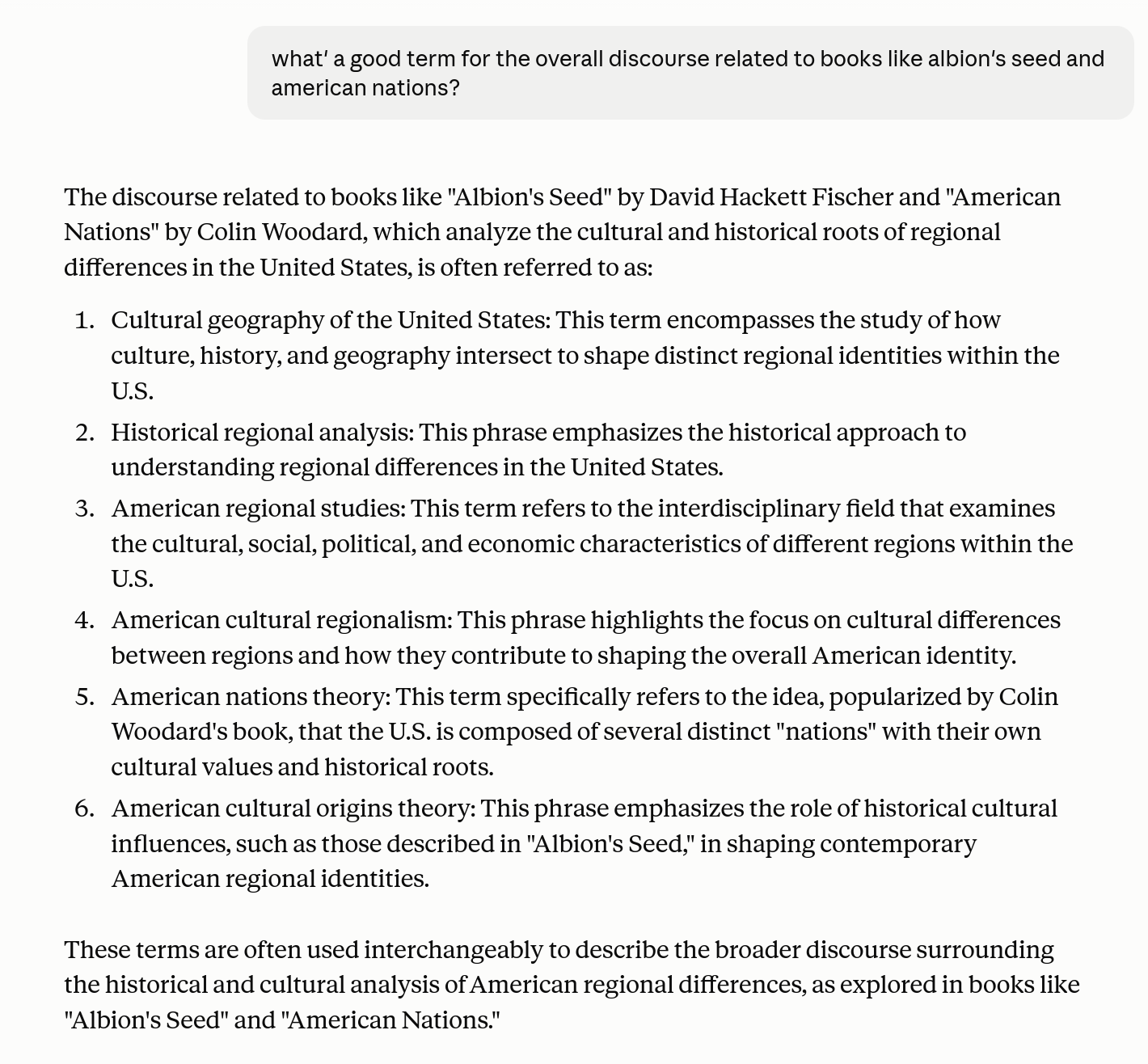
Anyway, what's the actual question, and what are the choices?
- Albions Seed Thought
- American Culturalism
- Regionalism
Evidence from history
It's also evident to me that even historically most people thought this way. OFC race is super visible and just like things such as "men wear earrings/don't", it's can be very very strong marker of group membership (in specific cases). Reading medieval books, you see people loving to talk about weird and fun cultural practices of their neighbors; race was mentioned, as were things like age, sex, religion, wealth, facial features, cleanliness etc. They're all both signifiers of personality and also ways to define the stereotype. True, I would agree there is implication that these might be somehow inherent/genetic to the person (or even to the group). But often, really, it also fits to interpret that as imlying that the society itself has a tendency to do things to make people that wayi.e. saying "people with long faces are mournful" works both ways, as a claim of genetic causality, or else of experiential causality. If someone says "all brits are stingy" I think it's fair to also read that as "british society (as it exists) has this bad trait of making people have to be stingy (and/or they're weak of character so they give in to stinginess". but still, at each point, substitute "that society and culture" for "that race" and to me it feels more aligned to the point someone is making than not.
Images
ChatGPT's reply